
The content landscape used to be a crowded room. Now it’s an even more crowded room, full of both people and robots, and the robots never stop talking.
With so much noise, buyers turn to voices they can trust. That’s why influencer content is becoming more strategically essential than ever. When B2B brands partner with authentic influencers and creators, they infuse their content with something machines can’t fake: real expertise, credible insight and a point of view buyers (and answer engines) value.
As Lee Odden put it in the opening letter of our 2027 B2B Influencer and Creator Marketing Report, “In a sea of AI-generated sameness, humanity is the differentiator.”
It’s not enough of a differentiator on its own, though. Our report found that 83% of senior B2B marketers are either running influencer programs or planning to launch one. This guide to B2B influencer content covers the what, why and how to help you set your brand apart from the field based on real data and real examples.
What is influencer content?
Influencer content is content created in collaboration with credible experts, practitioners and creators to reach and engage audiences through voices they already trust. Relative to B2C, influencer content in B2B focuses less on celebrity endorsement or playing purely for reach. It’s more about credibility, relevance and differentiated insight your brand couldn’t produce alone.
Increasingly, the people behind this content are called creators rather than influencers, a change in name that reflects a real expansion of the category. Today’s B2B creators include:
- The creator as expert: Analysts, consultants, practitioners and executives who bring credentials, deep domain expertise, or lived experience. This is the traditional B2B influencer archetype.
- The creator as entertainer: Podcasters, storytellers and satirists who bring media savvy and performance skill. Our data shows that 43% of very effective programs now partner with entertainment creators, compared with 25% of everyone else.
- Executives as creators: Very effective programs partner with executive-level leaders at nearly double the rate of all others (43% vs. 24%).
Influencer content collaboration can take several forms:
- Co-created assets, such as podcast series, research reports and newsletters that the brand and the creator build together.
- Expert contributions to brand content, such as quotes, commentary, interviews or guest perspectives.
- Creator-led content published on the creator’s own channels, often amplified with paid media.
- Ongoing advocacy from customers, partners and employees who speak credibly about the problems you solve.
Why influencer content is indispensable
There are a number of reasons why influencer content outperforms, but two core factors stand out above all others.
It gives content differentiated value
When anyone can generate a passable blog post in seconds, “passable” stops standing out. Creator content adds what AI can’t replicate (but prioritizes for citations): named expertise, first-hand experience and a perspective audiences recognize.
B2B marketers get this. In our survey they ranked trustworthiness/credibility and audience relevance as the top qualities they value in influencer partners. When creators help shape content, that content becomes grounded in your audience’s reality. It earns automatic credibility by association.
It’s how brands show up in AI discovery
Discovery has moved upstream. Buyers increasingly turn to AI engines for early-stage questions and searches, but research indicates that most B2B brands aren’t showing up. That’s not a problem that can be solved with more content.
According to Semrush, creator-centric channels like LinkedIn and YouTube dominate AI citations, with creator-led content specifically commanding an outsized share. Brand-owned content, meanwhile, is rarely getting surfaced in the responses from these engines.
Answer engines cite trusted third-party voices. Influencer content is how you produce those voices at scale, and how you control the conversation. As Trevor Pyle of Profound told us, “It’s essential to understand what AI is saying about your brand. It’s the most important influencer in the world right now.”
86% say improving AI and genAI visibility will be at least moderately important this year, but only 21% have made it a primary goal of their influencer program.
Pros and cons of influencer content
Pros
- Credibility you can’t manufacture. Creators bring earned trust with the exact audiences you’re trying to reach.
- Visibility in AI search. Credible third-party content is what answer engines tend to cite, so creator content helps with both human discovery and AI discovery.
- Full-funnel impact. Influencer content isn’t just an awareness pillar. Very effective programs use it more than others at every later stage of the buyer journey.
- Provable results. Only 3% of marketers leave influencer performance unmeasured, down from half in 2023. 92% are at least somewhat confident justifying influencer budget to a CFO.
Cons
- Relationships take real investment. Influence compounds over time, which means it can’t be rushed. Finding and qualifying the right influencers is the top challenge marketers cite (41%), followed by measuring results (37%) and managing ongoing relationships (33%).
- Measurement often stops short of revenue. It’s a challenge many marketers need to overcome. There’s a disconnect between what most marketers are reporting on (engagement and reach) and what leadership cares about (revenue attribution and pipeline).
- Campaign bursts underdeliver. One-off activations ask a relationship to prove itself before it has had time to mature, and each new campaign resets trust and relevance to zero. Commitment is key to success.
Best practices for impactful influencer content
Across five years of research, a few habits consistently separate the leaders from the pack when it comes to driving results with influencer-driven content.
1. Lean into durable formats
Leaders are thinking bigger than guest blogs and social posts. Compared with all others, very effective programs are more likely to invest in:
| Format | Very effective programs | All others |
| Podcasts | 37% | 19% |
| Research reports | 35% | 22% |
| Newsletters | 38% | 25% |
These formats are effective because they offer depth and durability. A single social post is a moment in time. Newsletters and podcasts lend themselves to diversity of perspective and a recurring cadence. Research reports combine POV with unique, valuable data. All of these formats create reusable, citable assets that keep paying off long after a campaign would have ended.
2. Integrate influence across the marketing mix
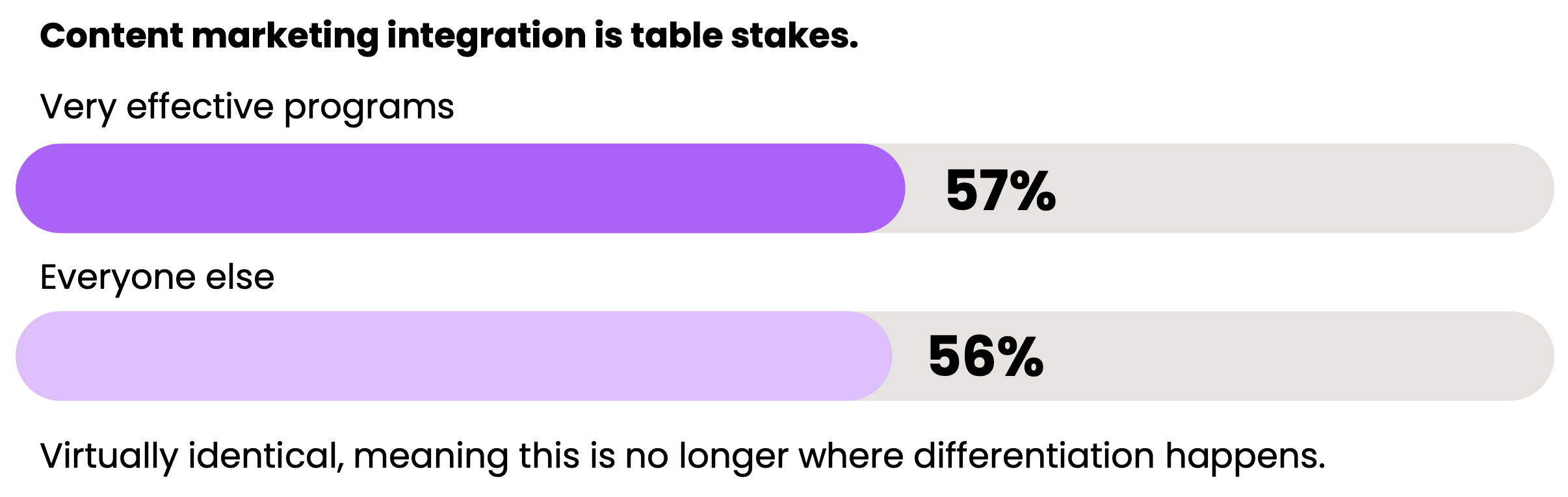
Strategic integration stood out as one of the biggest differentiators between leaders and laggards in our survey. Notably, what’s not a differentiator is integration between content marketing and influencer marketing: it’s become table stakes. But when you incorporate other key elements of your marketing strategy — AI search optimization, paid media, events, ABM, sales enablement — the impact of that influencer content elevates.
There’s a reason integrated strategy sits at the core of Best Answer Marketing.
3. Play the long game
Most of your buyers aren’t shopping right now. Research from the LinkedIn B2B Institute famously found that roughly 5% of potential customers are in-market at any given time, while the other 95% are not. The entire goal of B2B marketing is to reach and influence that 95% before they enter the 5%.
That means showing up where these people are, consistently, and connecting through voices they already listen to. According to 6sense’s study of B2B buyers, the winning vendor is already on the Day One shortlist 95% of the time, and four out of five deals go to the buyer’s pre-contact favorite.
Preference gets built during the months when nobody is buying. A campaign burst shows up for a few weeks and then goes quiet. An always-on creator program keeps credible voices in front of the 95% until they become the 5%.
Our research sees the same pattern. 72% of very effective influencer programs run always-on, compared with 27% of everyone else.
4. Treat influence like a business instead of a side project
Influencer marketing often starts as an experiment: a few creators, a campaign or two, and some reach numbers. The programs that scale are the ones that graduate to a real plan.
This is why strategy has to lead instead of tactics or tools. In their 2026 B2B content marketing trends report, CMI and MarketingProfs found that among factors contributing to improved content effectiveness, “strategy refinement” led the way by a healthy margin, with “new technology implementation” a distant second.
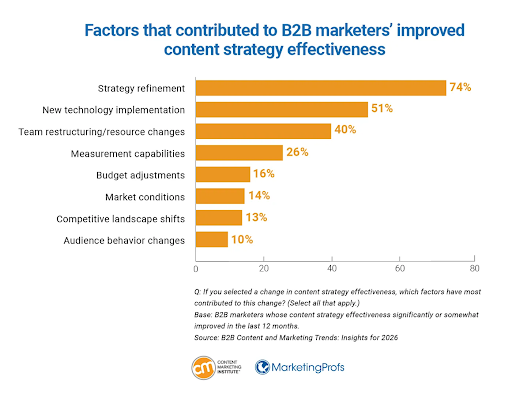
(Source: 2026 B2B Content and Marketing Trends Report)
Of note: bringing influencers and creators into strategy planning and refinement can be a powerful way to strengthen and solidify your partnerships. Our report found that co-creating content strategy is the second-most popular way for brands to build influencer relationships, trailing only ongoing communication.
Very effective programs are more than three times as likely to have a fully documented strategy. It’s the single biggest differentiator in our data.
Examples of influencer content in action
Asana: Always-on scale with a multi-tier creator mix
The challenge: Asana needed to build awareness and trust with SMB team leads and buying committees in a crowded productivity category.
The approach: TopRank Marketing built a long-term, always-on program with brand advocates, tech and productivity creators, and business leaders.
The results:
- 21.9 million organic views across 52 videos, 433% above the 4-million-view goal
- 126.4 million combined paid and organic views
- Nano creators (under 10K followers) outperformed their benchmarks and reached niche audiences broader placements couldn’t touch
The lesson: The advantage wasn’t found in any single creator tier. It was the sustained, always-on structure that let every tier do what it does best.
Avalara: Compounding authority through integrated content
The challenge: Avalara needed to reach Shopify’s merchant base as global tariff changes created urgency around international tax compliance.
The approach: TopRank built an integrated, always-on program pairing foundational content (an ebook, guide, webinar and a research report) with influencer and paid social promotion.
The results:
- 600K+ total reach
- An 8.7% landing page conversion rate, well above B2B software benchmarks
- Organic search traffic up 19%, non-branded keyword traffic up 16% and top-3 rankings up 12%
A checklist for successful influencer content in 2027
Drawn from the Best Answer Marketing Action Plan in our influencer marketing report, keep these checklist handy as you plan, prepare and publish influencer content.
- Document your strategy first
- Choose creators for trust and relevance over follower counts
- Commit to always-on relationships
- Invest in the relationship itself
- Co-develop at least one durable asset this year, such as a podcast series, research report or newsletter
- Make creator content citable (clear claims, named expertise and quotable framing)
- Integrate with paid, ABM, sales and AEO/GEO
- Measure what leadership values
Only 30% of marketers report AI visibility to leadership today. Those who feel very confident justifying budget to a CFO are nearly twice as likely to do so (38% vs. 21%).
The bottom line for B2B influencer content marketing
Influencer content works. Data shows most B2B programs are already seeing results. Elevating those results in 2027 comes down to three differentiating practices:
- Investing in durable, differentiated formats
- Integrating influence across the marketing mix, especially AI search
- Staying always-on so trust compounds over time
Get the full data, benchmarks and action plan in the 2027 B2B Influence & Creator Marketing Report, or explore our B2B content marketing services to see how we can help influence turn your brand into the best answer.
The post What Makes B2B Influencer Content Effective Right Now? appeared first on TopRank® Marketing.
from TopRank® Marketing https://ift.tt/NRmd51x


0 Comments