
The B2B creator marketplace is booming, and brands everywhere are coming to recognize the crucial value of partnering with credible voices. Forrester’s 2026 predictions suggested that 75% of enterprise B2B companies will increase their budgets for influencer relations.
Our own findings in the 2027 B2B Influencer & Creator Marketing Report revealed similar momentum across brands surveyed, with 83% of respondents either running, building or planning an influencer program within the year.
The report also goes into considerable depth about how these strategies are taking shape: the tactics, techniques and practices that separate those programs deemed “very effective” (less than half) from the pack at large.
If you’re looking for a detailed rundown of how B2B influencer marketing strategies come to life, you’re in the right place.
Tactics and techniques that will drive B2B influencer success in 2027
Before we dive in, an important preamble: getting the most out of these B2B influencer marketing tactics requires a bit of groundwork and planning up front. In our report, two of the biggest differentiators in effectiveness were documenting the strategy and using an always-on approach.
Take a big-picture view of how the following tactics can connect. Contextualize them within an integrated framework. Even if you’re not ready to bet big on a sustained always-on program from the start, you should build in plans for how you’ll take that step when you see results in a pilot or campaign.
To see start seeing those results, try these activations:
1. Launch a co-hosted podcast or video series with a creator
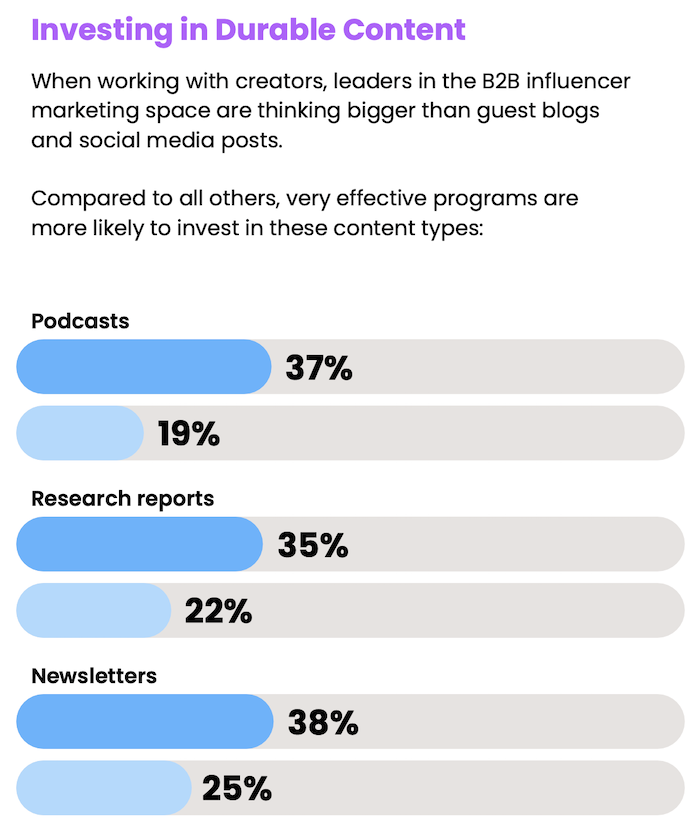
Social posts are where most B2B influencer programs start. The most effective programs go further and build serial content. Compared to all others, very effective programs are nearly twice as likely to co-create podcasts with creators (37% vs. 19%), and more likely to co-create newsletters (38% vs. 25%).
A series beats a one-off because every episode or edition builds on the last. In a recurring podcast, the creator’s audience gets used to seeing your brand, your experts get regular airtime, and each recording gives you clips, quotes and posts to use for weeks.
How to try it:
- Start with a short season. Commit to six episodes. A defined run is easier to approve and gives you a clean point to decide whether to renew.
- Pair a creator host with your own expert, or vice versa. The creator brings the audience and credibility. Your expert brings product depth. Interview, debate and “ask me anything” formats all work.
- Let the creator shape the format. Involve them in choosing topics and structure, not just showing up to record.
- Plan the clips before you record. Map out how each episode becomes short-form video, a newsletter section and a few LinkedIn posts. That way one session fuels a month of content.
Looking for a proven partner? Check out TopRank Marketing’s podcast services.
2. Co-author original research with a creator
With thought leadership becoming the gold standard of B2B content, research has become a hallmark for high-level influencer marketing. Very effective programs are more likely than all others to co-create research reports and thought leadership with creators (35% vs. 22%).
Buyers notice. According to Forrester’s Buyers’ Journey Survey, 2025, analyst reports are among the content assets and interactions business buyers find most meaningful. Creator-backed research covers both: authoritative findings, shared and analyzed by people buyers already follow.
How to try it:
- Pick one question your buyers argue about. Field a short survey, or dissect data you already have, then bring in a respected creator to interpret the results and add their perspective.
- Give the creator a byline, not just a quote. Co-authorship gives them a reason to promote the work as their own, which extends reach well beyond your channels.
- Plan the derivatives up front. One report can feed a webinar, a podcast episode, a social stat series and a sales leave-behind.
- Release findings in waves. Share one headline stat at a time, with the creator posting commentary on each, instead of announcing everything in a single launch post.
Learn more about using original research to elevate B2B marketing.
3. Build creator content that AI answer engines will cite
B2B purchase journeys increasingly start with an AI tool. In a Gartner survey of 645 B2B buyers, 45% said they used GenAI during a recent purchase, mainly to gather information on vendors and products. When those tools answer unbranded questions, roughly 89% of citations come from third-party sources rather than brand-owned content, per Bain & Company.
Credible creators are those third-party sources, so this is where influencer-driven content and AEO/GEO become the same tactic. Among marketers tracking AI impact from their influencer programs, 34% report their brand cited in AI-generated responses, 32% report Google AI Overview or SearchGPT appearances, and 31% report referral traffic from AI assistants. Only 8% tracked these outcomes and saw no impact.
Very few programs are pursuing this with intention. Only 21% have made AI/LLM visibility a primary goal for their influencer program. Most of the field hasn’t moved, which leaves room to get ahead.
How to try it:
- Create content focused specifically on the questions you want to answer. Brief creators on the actual prompts or queries buyers use. Encourage them to answer those questions directly, with clear claims and their credentials attached.
- Publish where answer engines look. Put creator content on crawlable surfaces, such as YouTube, Reddit, industry publications and creator newsletters, alongside social posts.
- Bring creators into your blog. Guest posts, expert quotes and roundups add named, firsthand expertise to owned pages.
- Run a manual baseline. Before you launch, ask a handful of AI tools your core category questions and note which brands and sources show up. Check again after 60 to 90 days.
Learn how our agency approaches SEO and AEO.
4. Put paid budget behind your best creator posts
Organic reach on social platforms is hard-won. Very effective programs don’t rely on it alone: 53% pair influencer content with paid media or paid social amplification, compared to 38% of all others.
This simple move can have an outsized effect. A creator post that is already performing has a proven message and a credible messenger. Paid spend gets it in front of the specific accounts and job titles you need.
TopRank’s work with Avalara, highlighted in the report, shows this effect. Paid influencer ads alone reached more than 315,000 people and drove nearly 11,000 landing page clicks.
How to try it:
- Let organic pick the winners. Run creator posts organically first, then put spend behind the top performers rather than guessing in advance.
- Write paid usage rights into the contract. Agree up front how long and where you can run a creator’s content as an ad, so a strong post isn’t held up by negotiations.
- Use platform formats built for this. LinkedIn’s thought leader ads and similar creator-ad formats keep the creator’s name and face on the post, which preserves the credibility that made it work.
- Target narrowly. Aim spend at your target account list or buying committee roles.
82% of B2B marketers who work with creators agree that influencer campaigns are essential to delivering measurable ROI (LinkedIn)
5. Bring creators on stage, and behind the scenes, at your events
Events put your brand in front of an engaged audience. Creators make them reach further and live longer. Very effective programs are more likely than all others to integrate influencer marketing with in-person or virtual events (49% vs. 34%). They are also far more likely to offer creators exclusive access to events, research or announcements (46% vs. 25%).
How to try it:
- Put a creator on the agenda. Have a creator moderate a panel, co-present a session with one of your executives, or host a live Q&A. Their presence gives attendees another reason to show up, and gives the creator’s followers a reason to tune in.
- Make them your on-the-ground correspondent. Give a creator backstage access and ask them to cover the event in their own voice through live posts, interviews and recap video. That turns a two-day event into a week of content.
- Give them news first. Brief trusted creators ahead of product launches or announcements so their commentary goes live at the same moment as your news.
- Extend the session. Turn a strong panel into a LinkedIn Live, a podcast episode or a short clip series after the event.
Learn how TopRank partnered with Sprinklr to achieve award-winning results with an influencer-driven masterclass event.
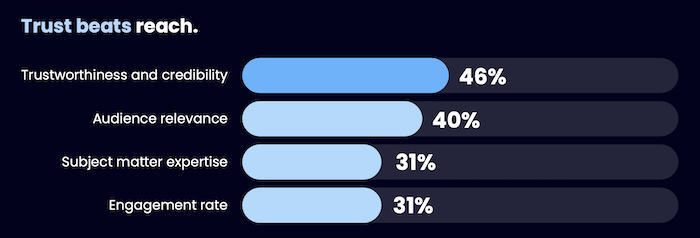
6. Recruit creators you wouldn’t expect, and choose them for trust
The B2B creator roster is getting wider, and dare I say weirder (affectionate). Very effective programs are much more likely than all others to partner with entertainment creators such as humor and microdrama accounts (43% vs. 25%), executive-level leaders with a public profile (43% vs. 24%), and journalists or media professionals (34% vs. 15%).
The B2B marketers seeing most success are thinking more openly about who can influence their audience, and how to collaborate with them.
How to try it:
- Add one wildcard to your next campaign. Test a single entertainment or satire creator who already pokes fun at your industry, alongside your usual experts. Give them room to be funny.
- Build a mix of creator sizes. Combine one or two large creators for reach with a group of small, niche creators for precision.
- Look in your own building. Your executives and subject matter experts can be creators too. Help them build a regular posting habit before you ask them to promote campaigns.
- Vet for audience fit over follower count. Check who actually engages with a creator’s posts before you look at their total followers.
Pick one, pilot it, then make it permanent
You don’t need all six tactics to see results. Pick the one that addresses your biggest challenge. If you’re invisible in AI answers, start with citable creator content. If you’re under pressure for fast pipeline results, try amplifying influencer content with paid media.
Whichever route you go, run it as a pilot with a clear goal and a set end date. If it works, it can grow into the always-on program that the most effective B2B brands run year-round.
Looking for more inspiration and context about the state of B2B influencer marketing and the mechanisms that make it work? Check out the full 2027 B2B Influencer & Creator Marketing Report, or explore TopRank’s influencer marketing services.
The post These Top Tactics Are Helping B2B Influencer Strategies Thrive appeared first on TopRank® Marketing.
from TopRank® Marketing https://ift.tt/FbSqchO


0 Comments